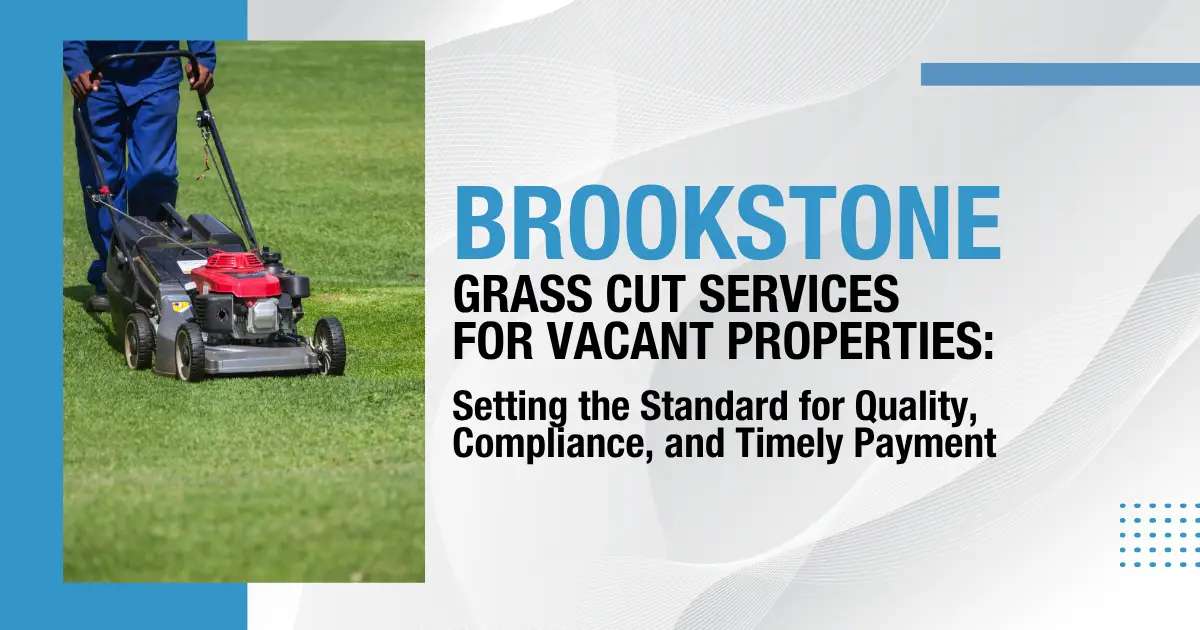
In the world of default servicing and property preservation, grass cut services for vacant properties are not a cosmetic afterthought. They are an operational necessity tied directly to asset protection, neighborhood stability, code compliance, and portfolio performance. At Brookstone Management, for properties up to one acre, grass exceeding three (3) inches must be cut down to a maximum height of two (2) inches. That disciplined approach is what makes Brookstone a Standard for Quality, Compliance, and Timely Payment for grass cut services.
A vacant property sends a message long before anyone enters the home. If the grass is overgrown, the perimeter is unmaintained, and curb appeal is visibly declining, the property immediately appears unmanaged. That perception can invite municipal scrutiny, neighbor complaints, vandalism risk, and faster deterioration in marketability. Consistent lawn maintenance helps control those risks while supporting the broader goal of preserving property value. Brookstone’s internal guidance makes it clear that grass cut services are a critical part of property preservation, neighborhood stabilization, and risk management, not simply routine exterior work.
The Brookstone Standard for Quality in Lawn Maintenance
Quality in grass cut services begins with clear service expectations. Brookstone requires vendors to perform lawn maintenance with precision, consistency, and site awareness. For properties up to one acre, grass exceeding 3 inches must be cut down to a maximum height of 2 inches. Edging is required around structures, trees, and planting beds, and all clippings and yard debris must be removed from the site. Bagged clippings cannot be left behind. For larger properties, vendors are required to maintain a one-acre perimeter and submit a bid for the remaining area. Even nontraditional landscapes such as desert, rock, or xeriscape layouts must still be maintained through trimming, weed removal, and cleanup.
These requirements matter because quality lawn maintenance is about more than mowing. It is about delivering a property condition that aligns with investor expectations, local standards, and resale readiness. A properly maintained exterior reduces visible neglect, strengthens first impressions, and supports safer access for inspectors, preservation crews, and listing professionals. On vacant assets, exterior presentation often becomes the first measurable indicator of whether the property is being actively managed.
Brookstone also expects vendors to operate professionally and safely at every location. That includes proper identification, accurate execution of the work order, and respectful behavior that avoids unnecessary interaction with occupants, neighbors, or local officials. In practice, that means quality is not judged only by the final cut height. It is judged by the full service experience, from arrival and documentation to cleanup and reporting.
Compliance Is Built on Documentation, Not Assumptions
In field services, compliance cannot rely on verbal confirmation or informal notes. It has to be documented in a way that supports approval, billing, and auditability. Brookstone’s guidance emphasizes that vendors must submit a complete, chronological record of services performed, supported by invoices, photographs, and notes that capture damages or security concerns. All work must be recorded through approved mobile applications, including check-in verification and Proof of Service questions. If documentation is incomplete or inaccurate, payment may be delayed, work may be rejected, or the invoice may be denied.
This is one of the most important realities in property preservation. The work itself is only part of the job. The record of the work is what proves compliance. In that sense, documentation is not administrative overhead. It is operational evidence. It confirms that the correct property was serviced, that the scope was completed, that the condition justified the invoice, and that the vendor followed the process.
For lawn maintenance services for vacant properties, this level of documentation is especially important because exterior conditions can change quickly. Growth rates, weather patterns, municipal exposure, and property-specific conditions all affect what is visible on the day of service. Without complete reporting, there is no reliable way to validate that the property was brought into compliance at the time of the visit.
Photo Standards Protect Everyone Involved
Brookstone’s instructions make clear that photos are the single most important factor in work order approval. Required images include address verification, street view, house number, before, during, and after photos, all four sides of the property, proof of grass height using a yard stick, equipment-in-use photos, and evidence of debris removal. Photos must be clear, in color, date-and timestamped, and free from edits or manual stamps. Dark, blurry, or altered images are subject to rejection.
From a technical standpoint, photo documentation functions as both compliance support and risk control. It protects the client by verifying completion. It protects Brookstone by supporting quality assurance. It protects the vendor by providing objective proof of performance. When photos are complete and properly captured, they reduce disputes, minimize rework, and create a more reliable path to approval.
That is one reason Brookstone’s system stands out as a Standard for Quality and Compliance, which ensures timely payment for lawn maintenance services.Faster payment is not created by speed alone. It is created by a process that reduces ambiguity. When the documentation package is complete, the approval path becomes far more efficient.
Timeliness and Workflow Discipline Drive Performance
Another defining part of Brookstone’s process is timeliness. Work orders must be accepted within one calendar day, and lawn maintenance orders must be completed within three calendar days. Rain is not considered a valid delay. These expectations show that lawn maintenance within the preservation space is treated as a time-sensitive service tied to compliance exposure and asset condition.
Brookstone manages this workflow through Aspen Grove iProperty, where vendors are expected to review orders daily and monitor statuses from ordered to approved. If a work order is rejected, corrections must be completed within 24 hours and addressed directly in the platform. Failure to correct within that timeframe can lead to cancellation and nonpayment. Brookstone also integrates with Pruvan and PPW to support accurate field reporting, and vendors must maintain active setup to remain eligible for work.
This is where operational maturity matters. Many service breakdowns in the field do not happen because crews cannot mow a lawn. They happen because timelines are missed, updates are not entered, supporting photos are incomplete, or rejections are not corrected quickly enough. Brookstone’s model makes those operational expectations visible upfront, which helps vendors perform consistently and reduces avoidable friction across the process.
Timely Payment Starts with Process Compliance
Timely payment is one of the strongest concerns for field vendors, and Brookstone addresses it through process clarity. Approved work orders are typically paid within 21 days, assuming photo, documentation, and invoice requirements are satisfied. That means the route to payment is directly connected to service accuracy, reporting quality, and workflow compliance. Payment issues and disputes are also channeled through a designated inquiry process rather than informal outreach, creating a more controlled and accountable system.
This matters because in the preservation industry, payment speed is rarely separate from documentation quality. Vendors who understand the process, capture the right evidence, and respond quickly to corrections are far more likely to avoid delays. Brookstone’s standards reinforce that relationship. Timely payment is not framed as a vague promise. It is presented as the result of doing the work correctly, documenting it thoroughly, and staying aligned with the required workflow.
Why the Right Lawn Maintenance Partner Makes a Difference
Brookstone’s approach to lawn maintenance services for vacant properties reflects a larger commitment to disciplined field execution. Lawn maintenance is not treated as a basic upkeep task, but as a compliance-focused service that helps protect asset value, reduce risk, and support property condition throughout the preservation lifecycle.
By setting clear standards for cut height, debris removal, photo documentation, mobile reporting, workflow timelines, and approval requirements, Brookstone has built a process designed to support quality outcomes and more reliable turnaround. That structure is what helps create a stronger standard for quality, compliance, and timely payment for grass cut services.
For vendors, the takeaway is simple. Strong performance is not just about completing the cut. It is about completing the work accurately, documenting it correctly, and following through at every stage of the process. In an environment where property condition and response time directly affect compliance and asset performance, that level of consistency matters. Learn more about Brookstone Management’s field service standards and property preservation solutions.